


Removing a tattoo is becoming easier and more effective. Tattoos that once might take 20-30 sessions (or more) to remove are now treatable in 3-5 sessions. It all comes down to the laser being used. Newer lasers can break down ink more efficiently, with fewer side effects and faster recovery. The best lasers for this are the picosecond (pico) lasers. At Schlessinger MD in Omaha, Nebraska, we offer laser tattoo removal via two cutting-edge picosecond lasers, a newer generation that works faster than the ones most people have heard of. Having both of these groundbreaking lasers gives our team more ways to approach your particular ink.
How picosecond laser tattoo removal works
What makes a tattoo permanent is that your body cannot physically move the ink. Cells in your skin constantly clear out debris, pick up small particles and carry them away. Tattoo ink is too big for those cells to move, so it stays exactly where it was injected into your skin. Like breaking up boulders into rocks and then rocks into pebbles, a laser breaks the tattoo ink into much smaller pieces, fine enough for those cells to remove, and the laser’s speed helps determine how effective the results are.
“Picosecond lasers are the best and quickest option for treatment of tattoos,” says Dr. Joel Schlessinger, board-certified dermatologist, Mohs surgeon and cosmetic surgeon. “If you think of it as you might think of a boxer punching his opponent, regular lasers are like a slow, hard punch that dizzies the opponent but doesn’t knock him out, while pico lasers are like a lightning-fast jab that results in a knockout.”
A picosecond is one trillionth of a second, a thousand times shorter than the nanosecond pulses used by traditional Q-switched lasers. At that speed, the energy behaves less like heat and more like a shockwave, which targets the ink itself rather than the skin around it.
“At 250 picoseconds, the Wontech devices that we have were developed in Korea and are the fastest picosecond lasers that exist,” says Dr. Daniel Schlessinger. “This makes them uniquely suited to remove tattoo ink better than any other laser on the market.”
The picosecond lasers you can expect at Schlessinger MD
Different ink colors respond to different lasers, which is why we use two. Our Pico Majesty and Pico Alex cover different parts of the color range, and most tattoos involve one or both, depending on the ink.
“Having both systems lets us match treatment more closely to the tattoo,” says Dr. Daniel Schlessinger, board-certified dermatologist, Mohs surgeon and cosmetic surgeon. “These Wontech picosecond lasers in particular are the world’s fastest picosecond lasers.”
“We’ve seen the newer Wontech devices dramatically improve tattoos within four to five sessions in many cases,” Dr. Joel says. “This is significantly quicker than standard lasers and the best part is that with two different pico lasers in the Wontech suite, we have the tools to address most colors with a great deal of efficacy and precision.”
Why the fastest way to remove a tattoo still takes time
Almost every consultation includes some version of this question, and the honest answer has two halves. The laser part has gotten faster, but your body still needs to haul away the broken-up pigment and get rid of it.
“The fastest way to remove a tattoo while preserving the surrounding skin is laser treatment with the right wavelength and settings for that particular tattoo,” explains Dr. Daniel. “Scheduling treatments too close together doesn’t necessarily make the tattoo disappear faster; probably the opposite, in fact.”
What moves things along is matching the laser to the ink, having the expertise to understand when the laser is at goal for optimal treatment and adjusting as the tattoo fades, while leaving enough room between sessions for healing and continued clearance.
What makes one tattoo harder than another
Two tattoos of identical size can behave entirely differently, and the variables aren’t always the ones patients expect.
“Tattoos tend to fade to some degree over time, which means an older tattoo is much more receptive to treatment than a brand-new tattoo,” Dr. Joel says. “But placement on the body isn’t as important as the depth of the needle placement. The deeper the tattoo ink is placed, the harder it is to reverse. Additionally, different colors within a tattoo, or a cover-up tattoo, make for more challenging scenarios.”
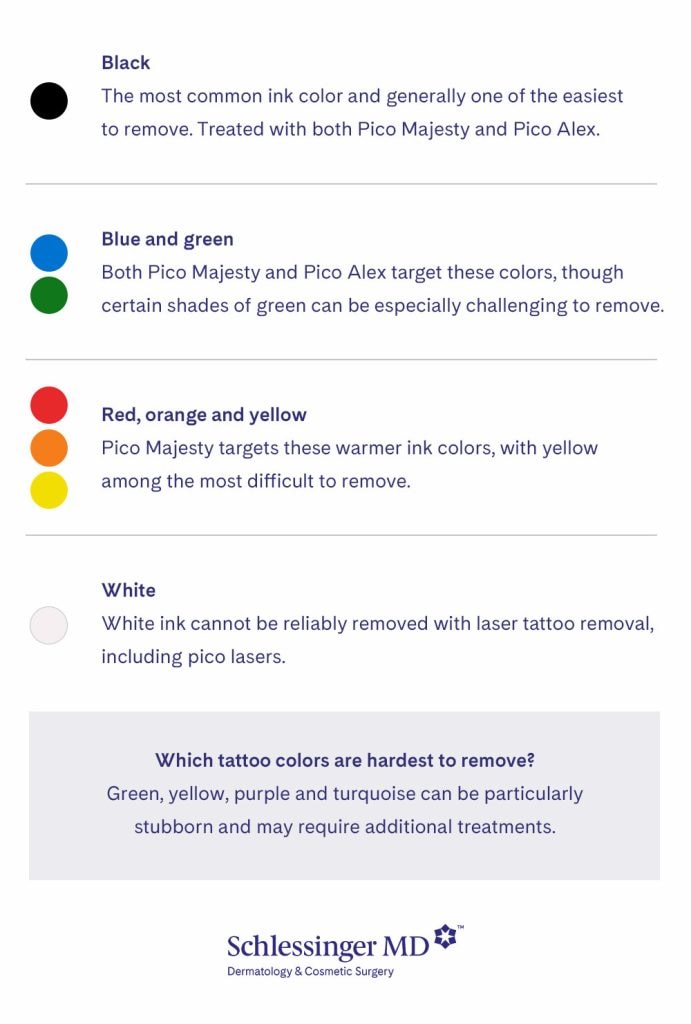
Color remains the other major factor. “Many people have tattoos that have been covered up and this is more challenging to address,” he adds. “Additionally, blue and green colors will always be more difficult to remove, though the newer pico lasers, such as the Pico Alex, work much better on these colors than previous lasers. Before, we would wince when we saw a blue or green tattoo, but now there are more effective ways to treat these with the Pico Alex!”
For a small number of cases, a second technology comes into play. “Occasionally, we might use a fractional resurfacing laser such as the Profractional Erbium to help speed up clearance of tattoos so the ink has a pathway out of the skin,” Dr. Daniel says, “but that is rarely required with Pico lasers.”
Ink that calls for extra caution
Some pigments react to laser energy in ways that have nothing to do with how quickly they clear. Recognizing those cases ahead of time, and planning around them, is why seeing a board-certified dermatologist is essential. They can help develop a treatment plan custom to your tattoo to ensure the best possible outcome.
Red ink is one of the pigments we’re cautious with. “If your tattoo is red, there is a chance that you will have an allergic reaction when the tattoo removal is performed,” Dr. Joel says. “In our clinic, we generally treat these with great caution to avoid an intense allergic reaction. This may mean that we do a test spot on it first.”
Permanent cosmetics are another. “Other areas of concern are black, brown and blue tattoos on the eyebrows from permanent brow liner,” he says. “These can sometimes turn from one of these colors to a reddish color when a chemical oxidation reaction occurs. This, again, is approached with great caution by our clinic.”
White ink sits outside what any laser can do at all. “White tattoos are essentially untreatable by any laser, including pico lasers, because of the titanium dioxide that gives it the white color,” Dr. Daniel says. “Similar to the titanium dioxide in mineral sunscreen, it scatters light so it’s essentially resistant to laser treatment no matter the laser, and can actually paradoxically darken when lasered.”
Knowing when not to treat matters as much as knowing how. “Sadly, we often see patients who come from other clinics or, especially, laser centers that are run by non-dermatologists or have no medical doctors at all who have been harmed by an overeager person who lasers a tattoo that is inappropriate for laser,” Dr. Joel says. Seeing a board-certified dermatologist is the most reliable way to avoid these outcomes.
Comfort and skin tone
A laser may target molecules other than your tattoo ink and can inadvertently go after your skin’s melanin. We account for both in our routine planning, and it shapes how we set up each session.
“In deeper skin tones, there is more melanin that can absorb laser energy, increasing the risk of burns or lighter and darker patches,” Dr. Daniel says. “For black ink, the 1064 nm wavelength is generally the preferred option because it is less strongly absorbed by melanin. That wavelength is available with our Pico Majesty. We individualize the energy and spot size, consider test spots and allow adequate time to assess healing before treating again. Recent tanning also matters, even in someone whose natural skin tone is lighter.”
Picosecond lasers are also more comfortable than traditional Q-switched lasers. “We certainly can numb, but what we have found with these new Pico lasers is that numbing is rarely if ever required with our techniques,” he says. “We use cool air to distract from the laser, which helps a great deal. Even for patients with admittedly low pain tolerance, they almost all say that these lasers hurt less than numbing injections, and much less or the same as when getting the tattoo in the first place.”
What to expect after each session
You’ll notice visible differences in your skin right after treatment. “Skin will normally have a glazed appearance after treatment and will gradually shed some of the skin while the area heals,” Dr. Joel says. “While the skin is open and/or healing, it’s important to avoid dirty water, such as pools, lakes or oceans, as this can lead to severe infections.”
Aftercare itself is simple. “After treatment, we recommend gentle cleansing, a thin layer of plain Vaseline and a nonstick dressing while the surface heals,” Dr. Daniel says. “Cool compresses can help with discomfort and swelling.” Picking at crusts, popping blisters, soaking or creating friction over the area can work against healing. Any increase in pain, spreading redness or drainage should prompt you to call our office.
“Sun avoidance between sessions is also very important,” he adds. “A tan can increase the risk of pigment changes and may require us to postpone the next treatment. Taking care of your skin between appointments is an essential part of getting a good result.”
If you have been considering pico laser for tattoo removal, you can schedule a consultation with Drs. Joel or Daniel Schlessinger through our appointment portal today.