


Hair loss has become one of the most common reasons we see patients at our office. This includes both men and women as well as younger and more mature individuals. The encouraging news is that most types of hair loss respond to treatment, and the right plan depends entirely on the cause. At Schlessinger MD, our board-certified dermatologists diagnose the specific form of hair loss first, then match it to the therapies most likely to help you regrow and keep your hair.
- Why hair loss treatment starts with a diagnosis
- Treating androgenetic alopecia
- Treating alopecia areata
- Treatment for other forms of hair loss
- Clinical trials for hair loss
- When to see a dermatologist
Why hair loss treatment starts with a diagnosis
Hair loss (also known as “alopecia”) is not a single condition. It is a group of very different conditions, each with its own cause and its own best treatment.
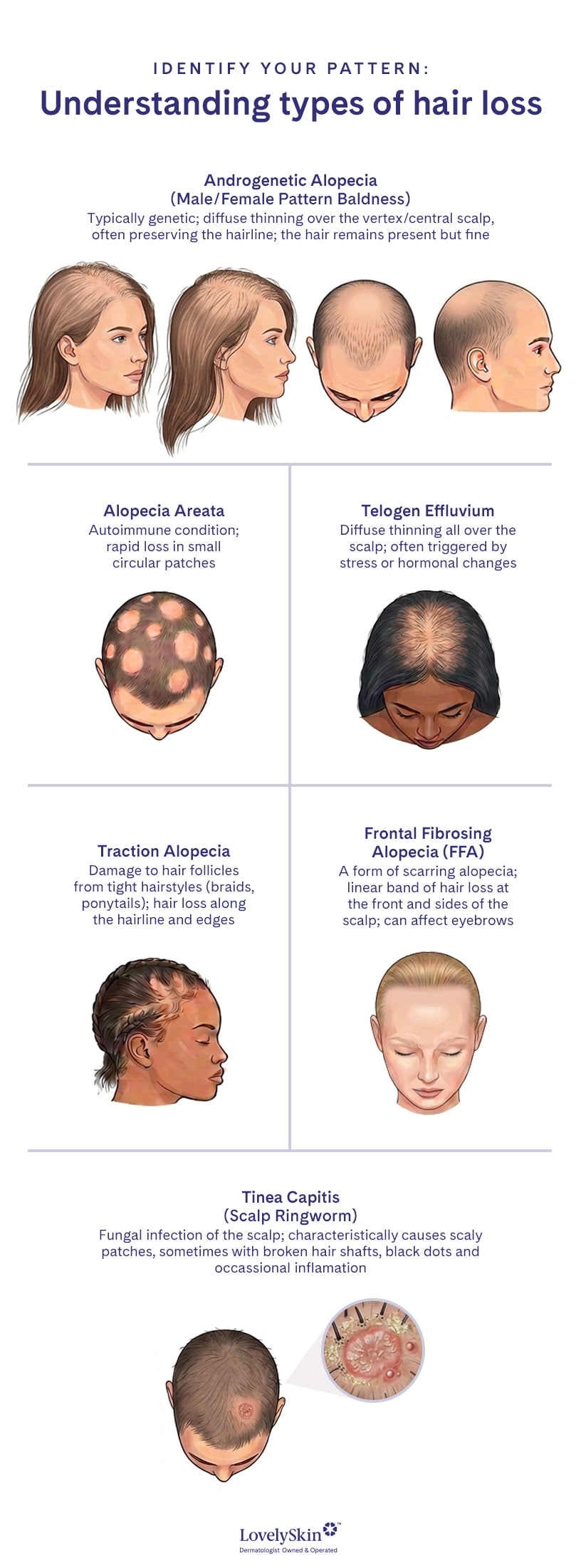
A few of the most common forms include androgenetic alopecia (male- or female-pattern hair loss), alopecia areata (autoimmune hair loss with shiny, completely hairless patches), telogen effluvium (sudden shedding that follows a stressful trigger), traction alopecia (hair loss from repeated pulling or tight styling), tinea capitis (ringworm leading to fungal infection of the hair follicles), as well as scarring types such as frontal fibrosing alopecia (progressively receding hairline and loss of eyebrows).
Because the treatments differ so much, our dermatologists begin with an in-depth history, a scalp and hair exam and tailored lab work when needed. Only then can we recommend a plan that targets your specific type of hair loss.
“It’s important to treat hair loss earlier rather than later, as there are easily treatable conditions that become permanent if patients wait too long,” says Dr. Joel Schlessinger, board-certified dermatologist, Mohs surgeon and cosmetic surgeon. “Our approach is thorough and solutions-based.”
Treating androgenetic alopecia
Androgenetic alopecia is by far the most common cause of hair loss in both men and women. It develops gradually as hair follicles shrink over time, partly in response to the hormone DHT. There are a range of treatments that may help this form of hair loss, and proven treatments can slow that process and encourage regrowth.
- Topical minoxidil (also known as Rogaine). Available over the counter as a foam or liquid, minoxidil is applied once or twice daily and extends the hair’s active growth phase. Most people see results after about four months of consistent use; however, this is extremely toxic to pets, so use caution.
“Rogaine was actually invented by a dermatologist from Omaha, Dr. Guinter Kahn, whom I am proud to say that I knew when he was alive,” says Dr. Joel Schlessinger. “I recommend the foam for the large majority of my patients, as the solution contains alcohols that sting for many people. In addition, I tell my female patients that they can use the men’s strength Rogaine once daily, which is more potent, generally safe for men and women, and less expensive than the women’s one.”
- Oral minoxidil. Prescribed off-label at a low dose, oral minoxidil is an option for patients who prefer a pill or find topical formulas hard to tolerate. Because it is taken internally, it requires a dermatologist’s guidance and monitoring.
“It is important to know that minoxidil, whether oral or topical, causes an initial shedding period,” says Dr. Daniel Schlessinger. “However, this shedding is temporary (I call it ‘out with the old, in with the new’) and increased hair density follows. Oral minoxidil is incredibly effective and is essentially fertilizer for the scalp, but it’s worth noting that minoxidil in all forms could also lead to excessive hair growth elsewhere.”
- Oral finasteride. Finasteride works by blocking the conversion of testosterone to DHT. It is FDA-approved for male-pattern hair loss and is not appropriate for anyone who is or may become pregnant, so it is prescribed with careful medical oversight.
“Oral finasteride has been around for many decades as a drug for men with prostate issues, and we have used it for treating and preventing male pattern hair loss for years,” says Dr. Daniel Schlessinger. “In recent years, I have seen oral minoxidil overtake it in terms of popularity because of concerns about sexual side effects and ‘post-finasteride syndrome’ with finasteride. Although I have never personally observed someone with these issues, there are many reports of them in online forums on Reddit and elsewhere, so it is something I always counsel my patients about.”
Dr Joel Schlessinger: I tend to avoid finasteride in my older patients as they are the ones who often have sexual side effects. Additionally, it can affect measurements of prostate-specific antigen (PSA) testing and needs to be taken into account if there are existing or future issues with the prostate.
- Spironolactone. Like minoxidil, spironolactone was originally developed as a pill to treat high blood pressure. It works for some women with female pattern hair loss by reducing the effects of androgens, such as testosterone, on susceptible hair follicles.
“Just as we can use spironolactone to treat hormonal acne in some women, we can also use it to treat hormonal hair loss in some women,” says Dr. Daniel Schlessinger. “It is not a heroic medication on its own, but it is a helpful tool in conjunction with other treatments. This treatment is not used in men due to the risk of feminization.”
- Platelet-rich plasma (PRP). PRP uses the growth factors in your own blood to stimulate the follicles. A small blood sample is drawn, concentrated in a centrifuge and then injected into the areas of thinning. Each session takes only a few minutes, and we typically recommend three initial treatments spaced two to six months apart, followed by maintenance every six months to a year. You can view before-and-after results from PRP performed at our Omaha clinic.
Dr. Joel Schlessinger: I call this treatment a ‘generic’ way to improve hair loss. Basically, it works on all types of hair loss, but in scarring or established hair loss it is much less effective, so it is important to treat with it early rather than late.
- Hair vitamins. Results from hair-growth vitamins for androgenetic alopecia are mixed, and supplements should complement–not replace–proven medical treatments.
“Some popular products, including Nutrafol, contain high doses of biotin that may interfere with common blood tests, and a recent case report also linked the multi-ingredient supplement to acute liver injury,” says Dr. Daniel Schlessinger. “For patients who want to add a nutritional supplement to their treatment plan, we generally recommend Viviscal Professional because it contains a more modest amount of biotin and has clinical data supporting its use in women with thinning hair.”
Viviscal Professional is available through LovelySkin.com.Viviscal PRO Hair Growth Supplement, which pairs the AminoMar marine complex with biotin, apple extract and vitamin C, helps to reduce shedding and strengthen thinning hair.
Treating alopecia areata
Alopecia areata is an autoimmune condition in which the immune system mistakenly attacks the hair follicles, causing round patches of loss that can sometimes progress to widespread or complete hair loss. Treatment aims to calm that immune response and restart growth.
- Corticosteroid injections. For limited patches, intralesional corticosteroid (also called Kenalog) injections delivered directly into the scalp are a common first-line treatment, usually repeated every few weeks.
- Topical corticosteroids. Applied as a cream, foam or solution, topical steroids are a gentler option often used for children or for larger areas.
- LATISSE®. When alopecia areata affects the eyebrows or eyelashes, this prescription bimatoprost treatment can help restore the appearance of fuller lashes and brows.
Newer systemic options: JAK inhibitors and Dupixent
For severe or widespread alopecia areata, the last few years have brought a genuine breakthrough in oral therapy.
JAK inhibitors work by quieting the JAK-STAT inflammatory signaling that drives the follicle attack. Three are now FDA-approved for severe alopecia areata: Olumiant® (baricitinib), Litfulo® (ritlecitinib) and Leqselvi® (deuruxolitinib), with Litfulo also approved for adolescents 12 years and older. These medications are taken long term, require regular monitoring and carry a boxed warning, so they are prescribed after a careful risk-benefit discussion with your dermatologist.
“Alopecia areata was once one of the most frustrating conditions to treat, with only modest options,” says Dr. Daniel Schlessinger, board-certified dermatologist, Mohs surgeon and cosmetic surgeon. “Through our clinical research side, we have actually performed dozens of trials on JAK inhibitors for alopecia areata and have witnessed how effective they can be. With that being said, they also carry significant risks and require regular bloodwork and office visits for monitoring.”
Dupixent® (dupilumab) may also be used off-label for alopecia areata and may be considered for patients whose hair loss occurs alongside atopic conditions such as eczema or asthma. By blocking the IL-4 and IL-13 signals behind that type of inflammation, it can help hair regrow in select cases while also treating the underlying atopic disease.
Treatment for other forms of hair loss
For the remaining types of hair loss, treatment is highly individualized because the underlying cause guides everything.
Telogen effluvium is temporary shedding set off by a trigger such as illness, major stress, thyroid changes, pregnancy, or significant weight loss, including the shedding some patients notice with GLP-1 medications. Once the trigger is identified and resolved, the hair usually recovers on its own, and we focus on supportive care in the meantime.
“Telogen effluvium is one of the most common forms of hair loss that we see, and it is also the most distressing to patients,” says Dr. Joel Schlessinger. “Thankfully, it nearly always goes away on its own, even without directed treatment, provided the original stressor resolves. With that being said, if there is a continual stressor, such as ongoing weight loss from a GLP-1 medication, the hair loss will persist.”
Ringworm, or tinea capitis, can also cause hair loss when fungus infects the hair follicles on the scalp. Unlike alopecia areata, the bald patches are usually scaly rather than smooth, and there may be pus discharge or crusting. Evaluation and treatment by a dermatologist is necessary, as this typically requires strong antifungal pills that often require bloodwork and monitoring.
Traction alopecia comes from repeated tension on the hair through tight hairstyles such as dreadlocks, braids, overly tight ponytails, or extensions. Caught early, it often reverses with changes to styling habits, but prolonged tension can lead to permanent loss.
“Additionally, hot oil treatments can scar the scalp and damage hair irreparably. The same thing goes for harsh chemicals in relaxers and permanents, says Dr. Joel Schlessinger. “I always tell my patients that natural is better and to avoid anything that feels bad on their scalp and hair.”
Scarring alopecias, including traction alopecia and frontal fibrosing alopecia, call for prompt anti-inflammatory treatment to preserve the follicles that remain. Frontal fibrosing alopecia, or FFA, is a form of hair loss that causes progressive receding hairline and loss of eyebrow hairs, typically in middle-aged Caucasian women.
“In recent years, we have seen an epidemic of mostly women suffering from FFA,” says Dr. Joel Schlessinger. “We have a variety of potential treatments, ranging from topical steroids to oral minoxidil and immunomodulatory medications like hydroxychloroquine or Plaquenil.”
Dr. Daniel Schlessinger has published research linking frontal fibrosing alopecia to a sensitivity to anti-frizz chemicals found in many hair care products, which is one more reason a precise diagnosis matters so much.
“When I was in residency, I was part of a research team that showed that a high percentage of patients with FFA appeared to be allergic to cetrimonium bromide, which is a chemical added to many hair-care products for its anti-frizz properties. We also showed that allergy avoidance led to improvement in subjective symptoms like itch,” says Dr. Daniel Schlessinger. “This is something that I discuss with all of my patients with FFA, and we offer an extensive patch testing panel in clinic that includes the test for cetrimonium bromide allergy.”
Clinical trials for hair loss
If standard treatments are not the right fit, you may be eligible for a clinical trial through the Schlessinger MD Skin Research Center, which has conducted more than 300 research studies on skin conditions and cosmetic procedures. Participating can give you early access to emerging therapies, and many studies include complimentary treatment along with compensation. You can view current studies to see what is enrolling now.
When to see a dermatologist
The sooner you understand the cause of your hair loss, the sooner you can take the right steps to improve it. A board-certified dermatologist can spare you the time and expense of products that may not even apply to your type of hair loss, and for some forms, early treatment is what prevents permanent loss.
If you are ready to understand your hair loss and explore the treatments that fit it, you can schedule a consultation with Drs. Joel and Daniel Schlessinger through our appointment portal today. Together, you will build a plan designed to help you achieve fuller, healthier hair.